Division 4, French politician Felix Faure (1841-1899):

President of France from 1895 until his death in 1899, his seemingly peaceful effigy belies the turmoil of the last years of his life, which saw his administration embroiled in the notorious Dreyfus Affair. Sculpture by René de Saint-Marceaux.
Division 11, Fernand Arbelot (1880-1942), effigy by Adolphe Wansart:

Little is known of Arbelot's life but perhaps his epitaph tells all we need to know:
Ils furent emerveilles du beau voyage/
Qui les mena jusqu'au bout de la vie.
"They were filled with wonder at the beautiful voyage/
Which carried them until the end of life."
Division 12, French painter Théodore Géricault (1791-1824). Sculpture of Géricault reclining with brush in one hand and his palette in another by Antoine Etex (buried in division 8 Montparnasse Cemetery). :

One of the pioneers of the romantic school of painting in France, Géricault is perhaps best known for his profoundly moving canvas, "Raft of the Medusa." Based on the story of one of the most horrific disastrous shipwrecks of the 19th century, the creation of the canvas is a tale all its own and one well-told by Jonathan Smiles in his masterful The Wreck of the Medusa (2007, Atlantic Monthly Press)
 |
| Medusa detail |

Division 18, French chemist and politician Francois Vincent Raspail (1794-1878):

Francois Vincent Raspail was imprisoned during the reign of Louis-Philippe (1830-1848) and again shortly after the aborted revolution in 1848. It was while he was in prison that his wife died. Sculpture representing the spirit of his dead wife attempting to visit him in prison by Antoine Etex (division 8 Montparnasse Cemetery).
Division 20, French actor and comedian Leon Noël (1844-1913); bust (1889) by Gustave Déloye:

"Leon" is "Noël" backwards and, "Noël" is, well, you get it.
Division 25, French librarian and historian Anatole de Montaiglon (1824-1895); death mask by Francois Sicard:

Division 27, Gillet family:

 |
| Gillet, detail |


Division 42, French sculptor Henry Triqueti (1803-1874), was noted primarily for religious themes. This haut-relief bronze sculpture was to honor his only son Edouard, who was killed in a horse riding accident in 1861. It represents Jesus raising Lazarus from the dead:
 |
| detail |

This monument consists of four statues:
 |
| Soldat de la lign |
 |
| l’Artilleur |
 |
| le Fusilier Marin |
 |
| La garde mobile |

Division 71, Joseph Croce-Spinelli (1843-1875) and Theodore Henri Sivel (1834-1875); effigies (1878) by Alphonse Dumilatre:

Both men died of asphyxiation when their balloon ascended too high. A third man, Gaston Tissandier (1843-1899) survived. Tissandier is buried in division 27.
Division 84, Achille Dester-Miard:

Division 88, American ballerina Harriet Toby (1929-1952):

Born Harriet Joan Katzman, she died in a plane crash with French actresses Michele Verly and Alice Topart. Every time I look at this relief I wonder, "How much of her short life did she spend up on her toes?"
Division 90, French socialist politican Auguste Blanqui (1805-1881); sculpture (1885) by Jules Dalou (buried in division 4 Montparnasse Cemetery):

Division 93, Jules Lewin (1847-1915):

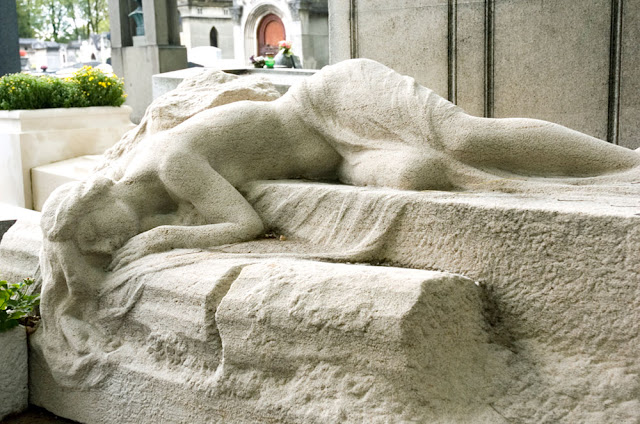
This isn't just a figure resting on a tomb lamenting the passing of someone buried beneath the stone; it's someone who is in pain so profound that all she can do is drape herself over the cold marble like a human shroud, forever placing that last kiss on the broken column representing a life cut short.
Division 94, Richard Valentin (1892-1916), fell at the Somme and Jean Valentin (1896-1916) was killed at Verdun. Sculpture by A. Chatillon:

Division 96, Paul Boucherot:

Little is known of Boucherot and his connection was to the Prometheus story remains a mystery.
Division 97, Memorial to the French Deportees for Compulsory Work Service in Nazi Germany during the Second World War; sculpture by I and J. Gallo:

Division 97, Memorial to the Jewish Deportees to the Oranienburg-Sachsenhausen concentration camp; sculpture by J. B. Leducq:

Division 97, Zerbini:

Who were they, these two, sharing a tender moment of affection forever carved in stone?